
The Potential of “Sustainability”
2014-03-05
Articles
(based on Paper presented at the Roundtable on Architecture and Urbanism in India, Mumbai, November 2003)
Preamble
The recent articulation in universal terms of the concepts of “sustainability” and “sustainable development” perhaps pre-sages an imminent paradigm shift in the reflexive practices of architecture and urbanism. The growing acceptance of the “sustainability” principle as the ideal that should guide the pursuit of the good life is an ironic counterpoint to the more dominant theme of globalisation.
“Sustainable development of human settlements combines economic development, social development and environmental protection, with full respect for all human rights and fundamental freedoms, including the right to development, and offers a means of achieving the world of greater stability and peace, built on ethical and spiritual vision”.[1]
The shift in this quotation compared with earlier similar creeds is in the inclusion of “environmental protection” as a pivotal value along with all the other normative values. By including environmental protection it establishes its role in ensuring stability and peace. Conversely, the environmental definition of sustainability is extended to include a sustainable order of human relations. Indeed as we read the “right to development” alongside “environmental protection” as a means towards stability and peace – the subtext of the need for a new discipline for development on the one hand, and on the other hand the potential of conflict over exploitation of environmental resource draws our attention.
Environmental protection envisages – first, the protection of the public commons of the earth’s natural environment – air, water, land – against pollution, and by extension, a discipline on the forms of exploitation of natural resource that would return and maintain them in their pristine purity and plentitude. This is, of course, a distant objective, and one might expect such an objective to significantly alter the present course of “development” world-wide. But that is not quite so. Today, global warming is being recognised as the single most pressing environmental threat. The strategy being prescribed for dealing with it is one of technological substitution rather than that of altering developmental goals. The underlying assumption of the “universal” statement of sustainable development, it seems, is a belief in the rightful and continued pursuit of material progress and a concomitant belief that the tools of modern science and technology will provide ever-expanding avenues of material well-being; It is also assumed that these tools would become available equally to all societies pursuing their right to development.
The “right to development” in today’s context refers to the march of globally networked operation of capital, finance and technology dominated by the North and, by the same token, to the aspirations of the South to join this march. And yet, it is evident that this march of capital seeking more and more profits from ever increasing levels of consumption would become the very antithesis of environmental protection. Ironically, the two ideologies of globalisation and environmental protection, while tending to contradict each other, have a common origin in the materialist model of development. And so, as the concept of sustainable development and its counterpart of sustainable habitat arrive in our part of the world, they arrive as a subset of that same model, carrying with it an inherent contradiction.
Of all human activity today, the construction and operation of buildings and urban infrastructures claim not less that 50% of the total energy consumed and an even greater proportion of the total consumption of organic & mineral materials. As our population increase and their aspirations and demands grow, the practice of architecture and urbanism would inevitably have to contend with the issue of sustainability.
Discussion
With this setting of “sustainability” as a defining principle for our futures, this paper seeks to start a discussion on the ways in which the concepts of sustainability and sustainable development can inform the practices of architecture and urbanism for our part of the world. We look at the inherent contradiction within the western model of sustainable development and we posit some alternatives to this model. Can the sustainability principle be received as knowledge and adapted locally? Can our adoption of this principle go some way toward responding optimistically to the first questions of this Roundtable “Why are our cities so unlivable? Why is the architecture we produce of such poor quality”?
The discussion is based on the following premise:
First: when we refer to the “quality of architecture” we refer to the breadth of our built environment and not only to the occasional or esoteric emblems of professional architectural practice. However, even as we say so, we recognise the architectural profession as perhaps the only reflexive and critical agent in the making of a “culture of building”, the more so today as the architect’s activity extends in reach and becomes more and more visible across the country.
Second: The quality of architecture – whether deplorable, inimical or cherished, results from the combined operation of a propelling ideology and processes of production. In this operation the designer plays the role of critical examination of variables around the locus of an examined ideology to synthesise an architectural product. The designer is the most critical actor in the process of building, and is not a mere cog in the wheels of production.
Third: Qualitatively “good” architecture would be one that enjoys the status of a cultural asset. This would occur when the ideological loci of architecture are located and absorbed in its host culture, and when designers have evolved a vibrant language as an explicit expression of such ideologies. It is only when this happens that a “good architecture” begins to contribute positively to the wider realm of the built environment and becomes an understood and cherished aspect of our “quality of life”.
Therefore, if sustainability were to make a difference to the quality of architecture, it would require to be absorbed as a critical ideology in the making of architecture. Through what routes and in which forms this might happen is something we speculate on. The clues lie in the ideological roots of the concept of sustainability itself.
Modern Project
In the form that sustainability is received by us as a global issue it is part and parcel of a continuing modern project. The democratic ideal, the universal pursuit of material wealth and faith in scientific knowledge are subsumed in it. The modern concept of sustainability is born out of a perception of the threat to a life-sustaining natural order. This perception grew with two parallel processes. The first process was the occurrence of pollution, floods and drought, which harmed human life directly and palpably, being identified as consequences of industrial development, coupled with population growth. Protecting the public commons of air, water and soil and retaining forest cover of the ground from the ravages of urban expansion and the demand of industry, became significant aspects of government programmes and attained worldwide recognition at the Environment Summit at Rio more than a decade ago. The other process has been the perception of much slower and more insidious global patterns of change in the natural environment. This perception has been made possible by the advance in the technologies of satellite communication and cybernetics and also the development of the science of ecology. That the changes in the global ecosystem could now be monitored has been a major impetus in concretising the “global village”, where responsibilities for the management of the environment will have to be shouldered collectively, transcending political boundaries. This is clearly recognized by the urgent focus on the effects of green-house gas emissions and ozone depletion causing global warming with potentially catastrophic consequences. At international fora, ironically, this results in yet another confrontation between the developed and developing nations: on the sharing of responsibilities for corrective action and equating rights of all societies to their pursuit of development. For the poor nations this is seen as a restriction on their aspirations for the good life, and for the developed nations it is seen as an added cost on their aspirations for the good life.
In its psychological dimension this conflict reflects the competitive instinct for advantage and survival. This competitive instinct is sought, in the utopian programme for sustainability, to be sublimated into enlightened self-interest by the socialist maxim of the equality of rights. This maxim is further idealised by its extension, not only to all subsets of the human species, but also to their future generations yet to be born, and finally, to the rights of other forms of life too. Here we see perhaps the beginning of a convergence between the modern derivation of sustainability and pre-modern concepts of a complex order of the universe to which human life can only be a subservient element. But, alas, these remain pious words as the modern project does not foresee a retreat from material development. On the contrary, it relies on the possibility of inventing technologies and practices that will enable continued development without depleting or despoiling the natural capital – “living only on its interest” and creating better and better conditions of material life!
Two other trends come to mind.
One trend is the beginning of a politically organised assertion of environmental protection. At the popular level, alongside the enlightened precincts of the professions, the “green” movement in the West has been gaining ground and, in some parts, has become a political force to reckon with. But its effective reach remains questionable in that it has not proposed an alternative model of development that would find popular acceptance. Similarly, the extensive legislation that is now coming into force for environmental protection and energy conservation in areas of the West, does not question demand. It adds costs of technology addition and of technology substitution, which will ‘pay off’ in the future. The real situation is that the drive for material security and progress which is inherited from the exponential expansion of industrial and technological infrastructure of over a century and a half has its own momentum. And while serious experiments in eco-living and bio-farming in the West, do serve as a questioning of the ethical basis of development, they do not displace its materialist foundations. The social and economic structures of the developed societies continue to be locked into highly consumptive habits. And it is these same structures that today symbolise the “rightful” aspirations of developing societies.
The second development is the theory of sustainability.
All over the west “sustainability” and “sustainable development” have become academic disciplines in their own right. Over the last decade a large amount of literature has been produced in this area and a theory of sustainable practice is now gelling into a firm and clear structure. At its apex the theory posits a mathematical model which equates “needs” of human development with “limits” of natural systems through the medium of technology. Technology is the dynamic denominator that would permit an increasing numerator of “needs” to be met within unchanging “limits” of natural systems. But it recognises that the world today is far from satisfying the sustainability equation. And so it proposes a gradual steering of the course of development toward the objective of satisfying the equation. One arm of the strategy toward this end prescribes the exercise of choice amongst alternative means to attain the same ends on the basis of evaluating the environmental impact of a product or a production system. It also draws sustenance from the Green movement and argues that consumer discretion coupled with legislation will modify the market of technologies and drive research in the direction of sustainability. The other arm of the strategy prescribes the test of efficiency. The greater the efficiency of a system of production, the smaller its environmental impact.
This theoretical structure is dependent on the development of scientific techniques and tools of measurement on the one hand, and on the other it requires development of alternative material and system technologies to serve existing or further needs. In other words the sustainability solutions are sought within the paradigm of technological progress. The assumption must be that the development of industrial and technological culture would describe a curve that would plateau along the resource consumption axis while it continues its climb along the development axis. The Buchminister Fuller model of abundance for all being created by the application of the scientific imagination for “livingry” rather than “weaponry” was the precursor to this vision. In the West, this vision continues to be a powerful inspiration for a strategy toward sustainability.
If we examine this theory of sustainability and its proposed strategy in the light of Habitat Agenda’s definition of “sustainable development of human settlements”, we will find it incomplete. It does not as yet integrate social and economic processes into the equation. Nor does it go further than paying lip-service to the role of ethics and spirituality in defining the purposes of science and technology.
At the popular social level, even as the ranks of subscribers to the sustainability ethos are growing slowly, many skeptics amongst them question the possibility of such a world and tend toward a tragic view that the human species, as did all other “ruling” species that are now extinct, can only enact its deathwish in a frenzy of a competition for survival. These skeptics say that if insatiable desire of the species is the engine of “globalisation” in a ‘free’ world it will inevitably lead to violent conflicts over the control of resources – witness the present struggles in Central Asia and the Middle-East!!.
Essentially then, the western definition of sustainability does not question its model of development, it only seeks to re-design the means toward its attainment. As a subset of the materialist model of development it tends to view sustainability as a challenge posed by development to be met by science and technology, rather than as a way of life founded and built up from a philosophy of sustainable practice.
Alternatives
The alternative theory of sustainability that provides a productive counterpoint to the presently dominant one discussed above, posits a symbiotic relationship between human activity and the natural world. The ideological root of this theory is pre-modern and perhaps more universal. The seeds of brotherhood and equality amongst men and of the notions of stewardship of the bounty of nature are sown in the creeds of Semitic religions. The common theme of compassion was expanded in Buddhism and had reached its abstract ideal in the Jain concept of ahimsa where the ‘other’ is unified into the ‘self’; right action or progress is nothing but participation in the processes of universal well-being. The fundamental divergence between this formulation of sustainability from the one discussed above is that in its operations it disciplines “need” as much as it disciplines “technology” in the sustainability equation. The overarching values of brotherhood, compassion and ahimsa condition “need” itself and so “need”, being the progenitor of technology becomes the primary level of discipline.
Schumaker translates this idea into a development ethic. The creative contribution of Schumaker’s thinking, in the context of the present discussion, is in recognising the validity of the principles of development of technological tools as multipliers of human energy, and of industrial production as a system for optimising resource. But these tools are subjected to new goals of development: those of producing dignity and grace – not merely plentitude and choice.
His prescriptive slogan “Small is Beautiful” suggests symbiotic systems that are democratically inclusive and beneficent. The symbiosis encompasses the natural environment in relation to human life and social organisation. This disciplinary framework is seen to determine the course of development of the material culture of societies. The ideology places the instrumental knowledge of Enlightenment at the service of the compassionate consciousness of Buddhism. Ensconced in it is an attitude that would naturally achieve technological development in directions that are protective of environment and less entropic in their manner of converting natural resource into products.
It is pertinent, at this juncture, to consider briefly the Gandhian alternative for sustainability. Unlike Schumacher, Gandhi labels modern science and technology as embodiments of evil power, and seeks a return to a romantic ideal of a stable harmony of a frugal, holistic way of life “where nothing is lacking.” Dignity is now to be found in self-reliance and in freedom from all exploitative structures. The prescription for achieving self-reliance here are the twin disciplines of frugality and abstinence to the point of denial of anything that calls for technological integration and capitalisation beyond the community of the village. This model translated into contemporary terms, for the purpose of this discussion only, rejects urban/industrial patterns of development altogether, advocates a return to Nature, and has a visceral distrust of industrial systems and products. This position today can only be seen as a romantic regression which has no pragmatic potential.
Ahimsa & Bhog
The concept of ahimsa is significant in that it prescribes a conscious respect for the “natural order of things”. However, as a negative term, it inculcates the attitude of abstinence and a certain kind of passivity for fear of doing harm. In contrast to the self-imposed abstinence of ahimsa is the hinduistic concept of bhog – of living with fullness and vigour that which is the gift of life – in bhog is the willing acceptance of the relationship with the phenomenal world celebrated as a conjugal partner, a positive complement, as it were, to ahimsa. It is an attitude of enjoyed action that rests in the lap of compassion protected from hinsa. Bhog suggests an active and deep knowledge of structures of the phenomenal world and the wisdom or ability to conduct an enjoyed life through a symbiotic interaction of human activity with living systems and natural processes. As it puts a higher premium on knowledge than on desire – it calls for the creative imagination to sow the seeds of desire in the soil of knowledge itself.
I would suggest that many of the cultural traditions of our part of the world embody the spirit of bhog – where the presence of the changing sky, the earth and soil, the cycles of seasons, breeze and rain, amplified by the ebb and flow of life – inform all celebratory forms of expression: poetry, song, music, painting and certainly architecture. The meaning of the courtyard, the jali, the chhatri – architectural forms that evolved through centuries – is the eloquent conversations with the sky, the seasons, the changing light of day. Equally, as precise and elaborated forms known and shaped by hand from raw materials such as stone, timber and mud, they convey an engagement of this imagination with an intimate bodily knowledge and respect for material resource. Such sensibilities and the spirit of bhog are still intact and alive – their clearest expression being the continually evolving forms of observing celebratory festivals that welcome the change of season and mark the rhythmic movements of the solar & lunar cycles. These are all cultural expressions of a sustainability ethic. Herein, perhaps, lies the key to the source of expressive languages for a contemporary architecture.
Architectural Practice and Environmental Degradation:
We now return to a “down to earth” assessment of our present stage of development.
At the operational level how does architectural practice contribute to global warming and environmental degradation? Global warming is primarily caused by the burning of carbonaceous fuels. Today, at a rough estimate, 50% of global CO2 emission is attributed to buildings – in the manufacture of materials of construction and their operational systems. Most of these are contributed by urbanised habitation. 20% of global CO2 emissions is contributed by transportation. Architectural practice and urban management and planning are, therefore, squarely implicated.
Environmental degradation and pollution of the commons of air, water and soil results from rapacious exploitation of natural resource and accumulation of waste by-products of industrial production. And densely populated settlements add to pollution of soil and water due to disposal of inadequately treated toxic wastes.
Given our inevitable subservience to the modern developmental project we are moving into a sharply rising urban/industrial curve. This will bring with it the expansion in building constructions and rising energy consumption thereby exacerbating CO2 emissions, a higher rate of depletion of natural resource and galloping environmental degradation. This is where strategic options that redefine need and technology must be exercised. We need to resist the glorification of and the tendency to clamber on to the present ‘hi-tech’ and high consumption bandwagon. Instead, we must look for materials and technologies for building construction that conserve resource and which obviate the high energy ced trend of unplanned urbanization is subjecting the majority of urban populations to untold misery and degradation of living conditions. The inherited models of town planning, infrastructure engineering and urban management have clearly failed. We need to do enormous amounts of inventive forward thinking on environmentally sustainable patterns of urban form and infrastructure and build institutional structures for their management, to ensure a measure of grace and dignity in urban life. And more importantly, we need to start re-defining our material needs and “life-style” aspirations on the basis of a sustainability ethic – an ethic signaled by the alternatives discussed above. This is where the agency of the design professions – including architects – is critical. It is they who, by professing their belief through their practice and by demonstration of their work, can provide “sustainable” solutions as cherished cultural symbols and as icons to inspire the public imagination. But there would be many “creative” minds amongst our profession who value their artistic freedom most of all. They would cite a conflict between the “higher” aesthetic and cerebral ambitions of architecture and the “mundane” concerns of sustainability. In their view of architecture this conflict is irreconcilable. Higher values – such as the mystical aura of glass and stainless steel must take precedence and exact their price in the exercise of artistic freedom. Or else architecture cannot flourish as an art. But they are talking not of artistic freedom, for freedom is exercised with knowledge and responsibility. They are talking instead of artistic license, which they would claim in the face of knowledge and responsibility. Admittedly no hard defining lines can be drawn in their argument. But it is to be stressed that, by definition, imagination and creativity can never be constrained, least of all when they are supported by knowledge and guiding principles.
Possibilities
Christopher Day in his essay “Building-in soul” sums up the simple and commonly available technological option admirably:
The more local and unprocessed materials are, the less the transport and manufacturing energy and pollution, the more health benign, the better for local employment. Local traditional materials also connect us with the cultural continuum of the past and enable us to connect it to a future inspired by different ideals….so local materials have energy, minimum pollution, social, economic, cultural, self-esteem and spiritual benefits – and shape of course, the character of a place – its identity.[2]
This strategy deals with sustainability-directed utilization of material resource for building construction. A complementary strategy is what is now termed as bio-climatic design – which incorporates, in addition to the material means cited above, the formation of space and arrangement of building elements and simple devices to respond to climate and thereby produce desired comfort. The forms generated by this strategy express our relationship with the cycle of seasons and the rituals of living that are particular to a climatic region.
Christopher Day’s prescription reads like a pragmatic translation of the United Nations Habitat Agenda. When we combine this prescription with bio-climatic design we see sustainability being rooted in regional cultures. It provides a basis for initiatives in development of cultures of building that grow as regional continuities: Cultures of building that, like the vernacular traditions, would not be alienating but integrating, and at the same time be enjoyed for their expressive beauty.
If “self-esteem” and “spiritual benefits” are also goals of sustainable development, then the sustainability principle finds a resonance in the ideologies embedded in our cultural traditions. The symbolic rituals which continue to be performed to sanctify all acts of building, contain the messages of sustainability and ecological balance. They seek permission from all forces of Nature and other living beings and seek forgiveness for the necessary violation of the earth. These ideologies now call for their translation into a contemporary culture of building.
Here it is important to caution against any romantic regression into “the wisdom of our ancestors”. The current fad of “vaastu” is a case in point. Blind and unquestioned following of received rules from the shastras is as pernicious as an unexamined acceptance of glitzy symbols of success from Dubai or Shanghai! One of the great boons of the internet revolution is the accessibility of information and knowledge across the globe. To move in the direction of sustainability from the reality of our present situation one would take advantage of this boon and bring all available knowledge to the service of sustainable practice.
Quality of Architecture
To return to the premise of this discussion, how does this way lead to an improved quality of architecture? This possibly can be identified in several processes that are extant across the subcontinent. I chose a symbolic triumvirate to share my optimism. Geoffrey Bawa, Joseph Allen Stein and Laurie Baker, I would argue, have produced architectures that are inspired by a sustainability ethic. In each case, and this is extremely significant, they have produced a culture of building that integrates the total process of the making of architecture. The resource base of material and skill, the continuities of cultural languages and the recognition of the physicality of climate and geography all converge to make the architectural expression. Their architectures have established a deep resonance with their host cultures. They grow from within even as they appropriate universal knowledge. This triumvirate also symbolises the validity of the sustainability principle across the total range of the built environment - from the simple shelter of a home to a complexity of intense urbanism.
Geoffrey Bawa
In Sri Lanka, Geoffrey Bawa was primarily responsible for elevating the Sri Lankan inheritance of a sensible and natural vernacular architecture into a contemporary symbol of enlightened good taste and graceful living. His design for the most sophisticated homes for the wealthy, of resorts for international tourism, or for simple middle-class homes and institutions, deployed similar architectural vocabularies derived from the same principles of design. The Triton Hotel, for example is conceived as verandahs and loggias sheltered under a great roof, interacting with the landscape – its views, the breeze and rain and the constantly changing light. The materials of construction are not “modern or contemporary” – simple white plastered walls, terracotta tiles on floors and for roofing, local timbers, rattan with batik for colour. The only air-conditioned spaces which are enclosed by glass are the restaurant the bedroom.
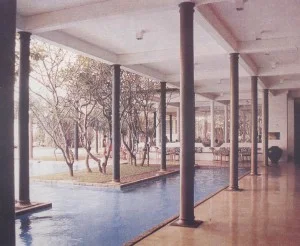 Triton Hotel – An architecture of verandahs and loggias
Source: A+D, Mar-Apr.1990
Triton Hotel – An architecture of verandahs and loggias
Source: A+D, Mar-Apr.1990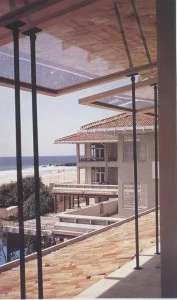 The weather and the natural order is “permitted” into the architecture rather than denied or excluded. The “smooth and shiny” aesthetic of mechanized production is shunned; on the contrary, natural textures and variations of craft are enjoyed. All of this makes for a simple yet generous architecture where quite naturally and sensibly the hotel staff will stay barefoot, and encourage the guests to do the same!
Geoffrey Bawa has succeeded in establishing a culture of building whose worth is enshrined in the grace and joy of symbiosis between people and environment, produced by simple means rather than by the drama of material excess and the prowess of high technology. This is, perhaps, his most significant legacy.
Joseph Allen Stein
At the Habitat Centre, New Delhi, Joseph Stein proposed an urbanscape for the north Indian metropolis. This complex of institutional offices with recreational & conference facilities is perhaps the first and only attempt at finding a prototype for contemporary needs. It attempts to harness the economies of scale of large urban development to produce a sheltered public space of leisure and congregation among plants and water, where the changing light of seasons plays on patterned floors and a rich texture of brick stone and glazed tile, recalling the city’s architectural traditions. The enclosed workspaces too are oriented primarily towards the shaded courts with wide strip windows. In contrast narrow vertical slits on the outer face of the buildings turn away from the harsh out-of-doors surrounded by vehicular movement. Although the facilities are patronized by the upper crust of society and built for their benefit – the public space is conceived as an open pedestrian continuum that would connect and integrate the neighbourhood.
The weather and the natural order is “permitted” into the architecture rather than denied or excluded. The “smooth and shiny” aesthetic of mechanized production is shunned; on the contrary, natural textures and variations of craft are enjoyed. All of this makes for a simple yet generous architecture where quite naturally and sensibly the hotel staff will stay barefoot, and encourage the guests to do the same!
Geoffrey Bawa has succeeded in establishing a culture of building whose worth is enshrined in the grace and joy of symbiosis between people and environment, produced by simple means rather than by the drama of material excess and the prowess of high technology. This is, perhaps, his most significant legacy.
Joseph Allen Stein
At the Habitat Centre, New Delhi, Joseph Stein proposed an urbanscape for the north Indian metropolis. This complex of institutional offices with recreational & conference facilities is perhaps the first and only attempt at finding a prototype for contemporary needs. It attempts to harness the economies of scale of large urban development to produce a sheltered public space of leisure and congregation among plants and water, where the changing light of seasons plays on patterned floors and a rich texture of brick stone and glazed tile, recalling the city’s architectural traditions. The enclosed workspaces too are oriented primarily towards the shaded courts with wide strip windows. In contrast narrow vertical slits on the outer face of the buildings turn away from the harsh out-of-doors surrounded by vehicular movement. Although the facilities are patronized by the upper crust of society and built for their benefit – the public space is conceived as an open pedestrian continuum that would connect and integrate the neighbourhood.
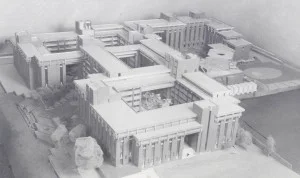 Habitat Centre – Prototype for a North Indian urbanism
Source: Stephen White, The Architecture of Joseph Allen Stein, OUP.
Habitat Centre – Prototype for a North Indian urbanism
Source: Stephen White, The Architecture of Joseph Allen Stein, OUP.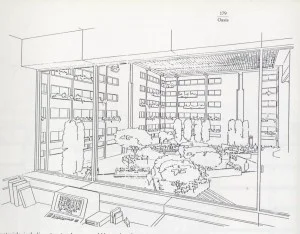 The materials of construction – specially the external finishes of the complex are indigenously produced and utilise local resources. Even though Stein has often mourned the gradual deterioration and loss of the finer skills of craftsmanship in the building industry over the years – he has sought solutions that do not displace the local crafts by simply resorting to wholesale import. Instead, he uses a simple but skillful deployment of stone terracotta, brick and glazed tile – all of which belong to this region, to create a rich experience.
The shaded and planted courts create a microclimate that makes the out-of-doors habitable during the hot summer season. This modified microclimate coupled with a cavity wall construction and controlled use of glass makes for an effective strategy in reducing air-conditioning loads.
Laurie Baker
Laurie Baker has been a fine practitioner of ethical professional service whose objective has been to produce dignity and grace with frugal means. The lesson of his life-work is most significant in that he practiced a design-&-build service which synthesized creative inventiveness of form and technique, the development of building craft and skills and management of resource of material and money – to always give more than what was expected within the available means. And to top it all the architecture would be witty and delightful even as it would be sensitively provide for a well-understood way of life.
It is an architecture that finds its expressive language from an intelligent use of locally available materials, a way of building that provides sustainable employment and builds the capital of skill and knowledge locally, and a demonstration of a life style of simple needs and graceful living. It is an architecture that has grown from within and is intrinsic to a place and people. A Laurie Baker home is cultural asset for it truly belongs.
This I would term “a complete architecture” and recommend it as a conceptual model for the development of sustainable habitat.
The materials of construction – specially the external finishes of the complex are indigenously produced and utilise local resources. Even though Stein has often mourned the gradual deterioration and loss of the finer skills of craftsmanship in the building industry over the years – he has sought solutions that do not displace the local crafts by simply resorting to wholesale import. Instead, he uses a simple but skillful deployment of stone terracotta, brick and glazed tile – all of which belong to this region, to create a rich experience.
The shaded and planted courts create a microclimate that makes the out-of-doors habitable during the hot summer season. This modified microclimate coupled with a cavity wall construction and controlled use of glass makes for an effective strategy in reducing air-conditioning loads.
Laurie Baker
Laurie Baker has been a fine practitioner of ethical professional service whose objective has been to produce dignity and grace with frugal means. The lesson of his life-work is most significant in that he practiced a design-&-build service which synthesized creative inventiveness of form and technique, the development of building craft and skills and management of resource of material and money – to always give more than what was expected within the available means. And to top it all the architecture would be witty and delightful even as it would be sensitively provide for a well-understood way of life.
It is an architecture that finds its expressive language from an intelligent use of locally available materials, a way of building that provides sustainable employment and builds the capital of skill and knowledge locally, and a demonstration of a life style of simple needs and graceful living. It is an architecture that has grown from within and is intrinsic to a place and people. A Laurie Baker home is cultural asset for it truly belongs.
This I would term “a complete architecture” and recommend it as a conceptual model for the development of sustainable habitat.
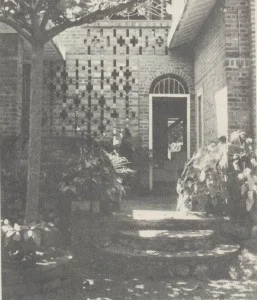 House for Lt. Col. John Jacob, Trivandrum
 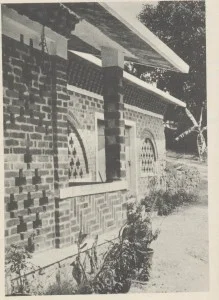 Nirmithi Kendra, Trivandrum
Inventive & imaginative use of local resources of material & skill
Source: Gautam Bhatia, Laurie Baker, Life, Work, Writings, Viking/Hudco
Conclusion
A cultural continuum and the active participation of society in steering its course are both pre-requisites for producing quality with authenticity. In this context I would argue that the philosophical and spiritual moorings of sustainability are part and parcel of our varied cultures and our deep structures of thought. Sustainable habitat is to be seen not merely a matter of technology substitution. Its true meaning is in finding methods of providing for and in defining the gamut of needs and aspirations that constitute our habitat, inspired by the philosophy of sustainability. It is when we apply modern knowledge, with an attitude of ahimsa and compassion, enlivened by the bhog of the gifts of nature; it is when we exercise our imagination to give form and expression to this cultural inheritance, that we shall make an architecture that produces joy and beauty founded on an essential knowledge of our place in the world. Critical architectural practice that adopts the foundational ideologies of sustainability as embedded in our continuing cultures, has the potential of engendering an alternative sustainable life-style for our future generations – a life-style of grace, dignity, and beauty.
Nirmithi Kendra, Trivandrum
Inventive & imaginative use of local resources of material & skill
Source: Gautam Bhatia, Laurie Baker, Life, Work, Writings, Viking/Hudco
Conclusion
A cultural continuum and the active participation of society in steering its course are both pre-requisites for producing quality with authenticity. In this context I would argue that the philosophical and spiritual moorings of sustainability are part and parcel of our varied cultures and our deep structures of thought. Sustainable habitat is to be seen not merely a matter of technology substitution. Its true meaning is in finding methods of providing for and in defining the gamut of needs and aspirations that constitute our habitat, inspired by the philosophy of sustainability. It is when we apply modern knowledge, with an attitude of ahimsa and compassion, enlivened by the bhog of the gifts of nature; it is when we exercise our imagination to give form and expression to this cultural inheritance, that we shall make an architecture that produces joy and beauty founded on an essential knowledge of our place in the world. Critical architectural practice that adopts the foundational ideologies of sustainability as embedded in our continuing cultures, has the potential of engendering an alternative sustainable life-style for our future generations – a life-style of grace, dignity, and beauty.
[1] Preamble to “The Habitat Agenda”, United Nations. [2] Sue Roaf, Manuel Fuentes, Stephanie Thomas, Ecohouse – A Design Guide, Architectural Press, 2001, p.93
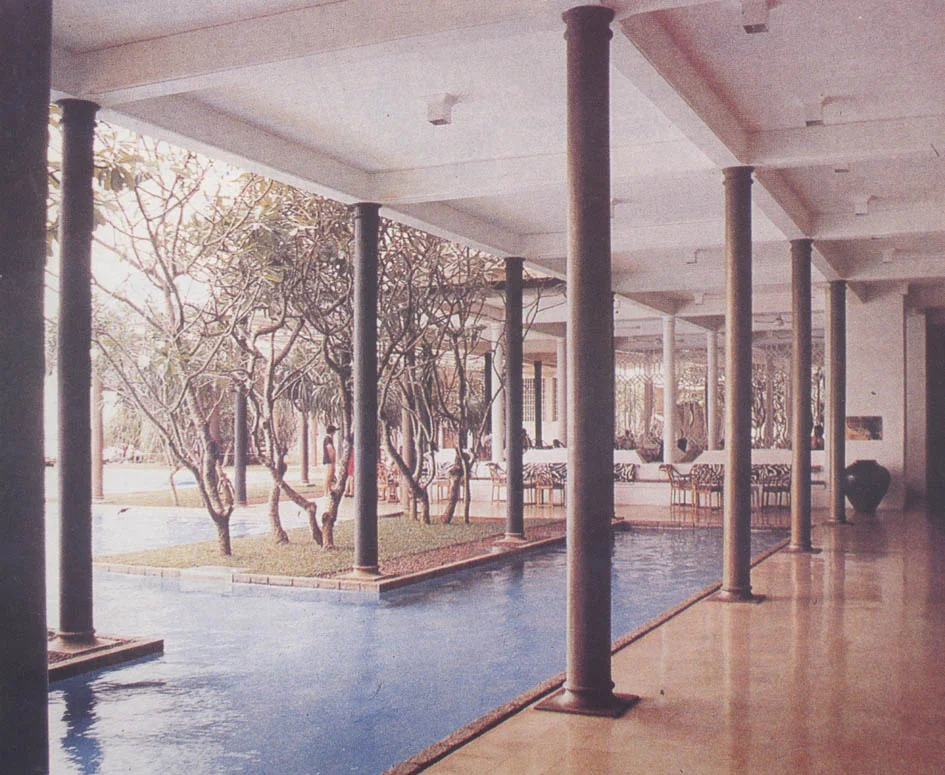 Triton Hotel – An architecture of verandahs and loggias
Source: A+D, Mar-Apr.1990
Triton Hotel – An architecture of verandahs and loggias
Source: A+D, Mar-Apr.1990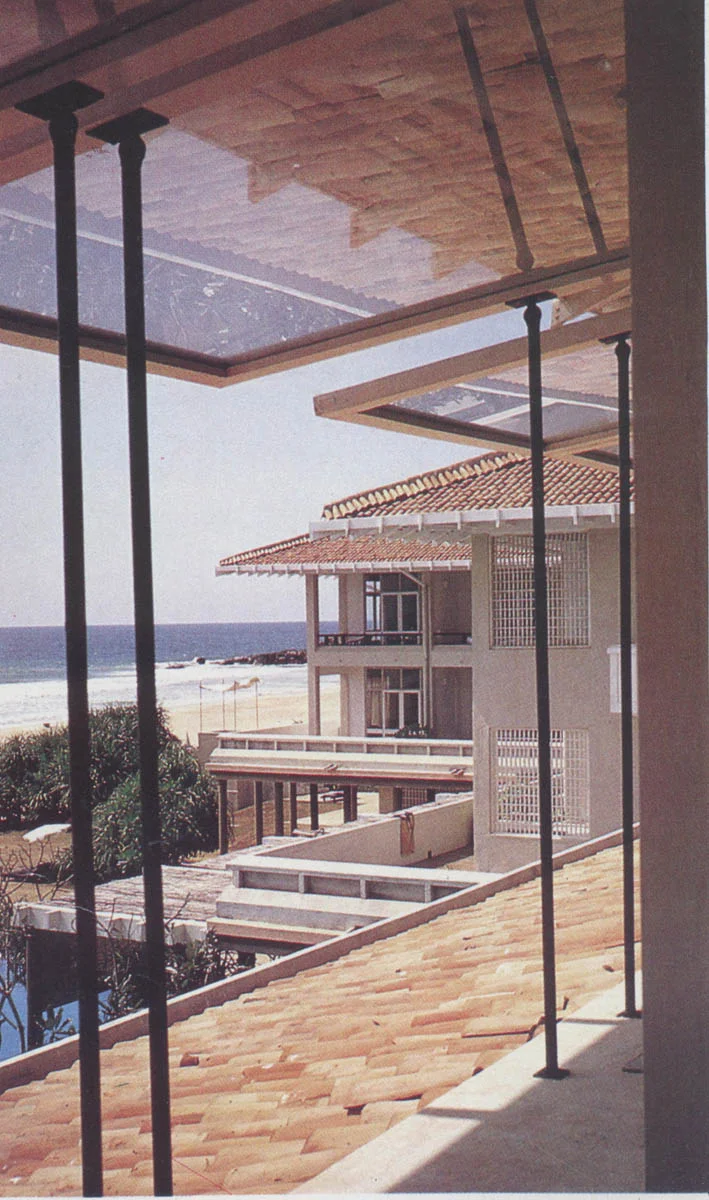
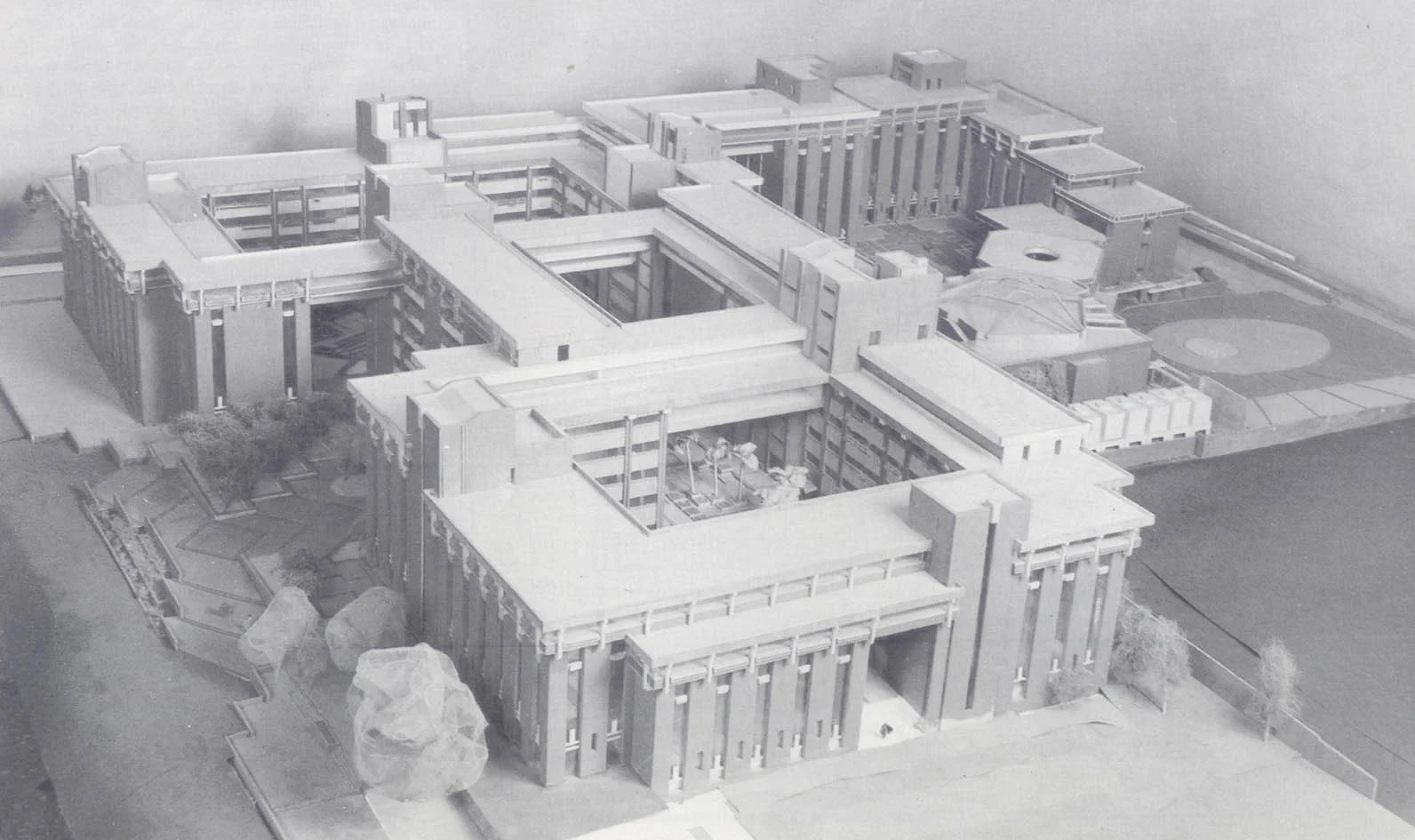 Habitat Centre – Prototype for a North Indian urbanism
Source: Stephen White, The Architecture of Joseph Allen Stein, OUP.
Habitat Centre – Prototype for a North Indian urbanism
Source: Stephen White, The Architecture of Joseph Allen Stein, OUP.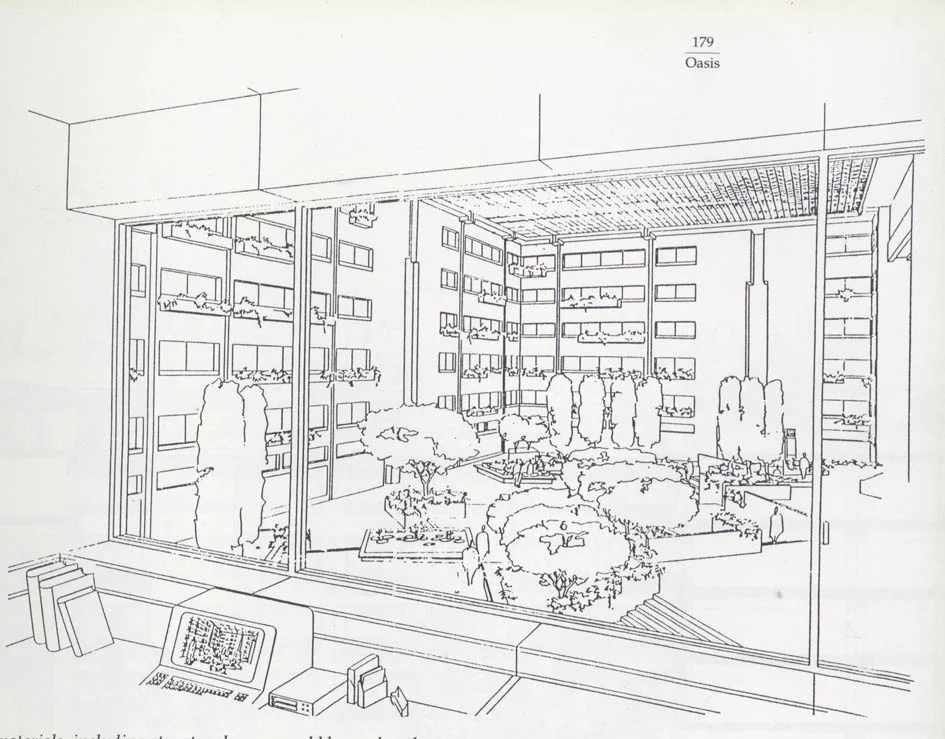
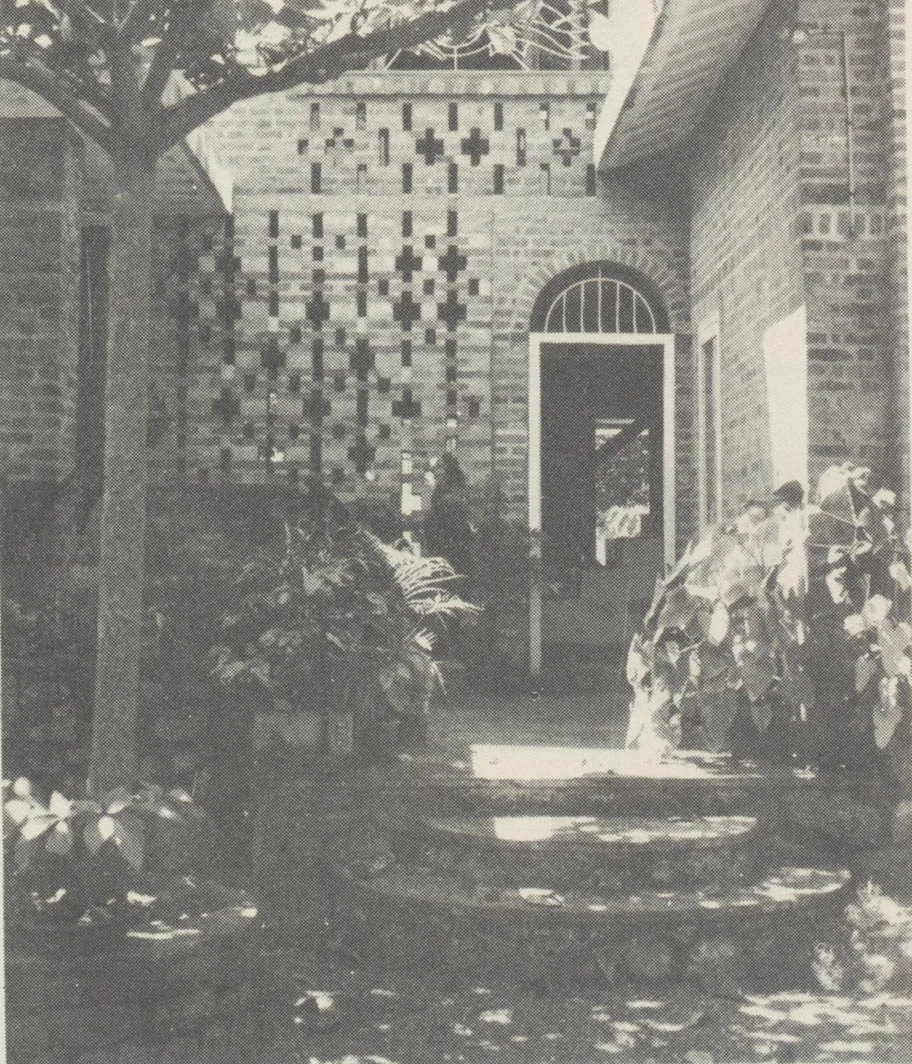 House for Lt. Col. John Jacob, Trivandrum
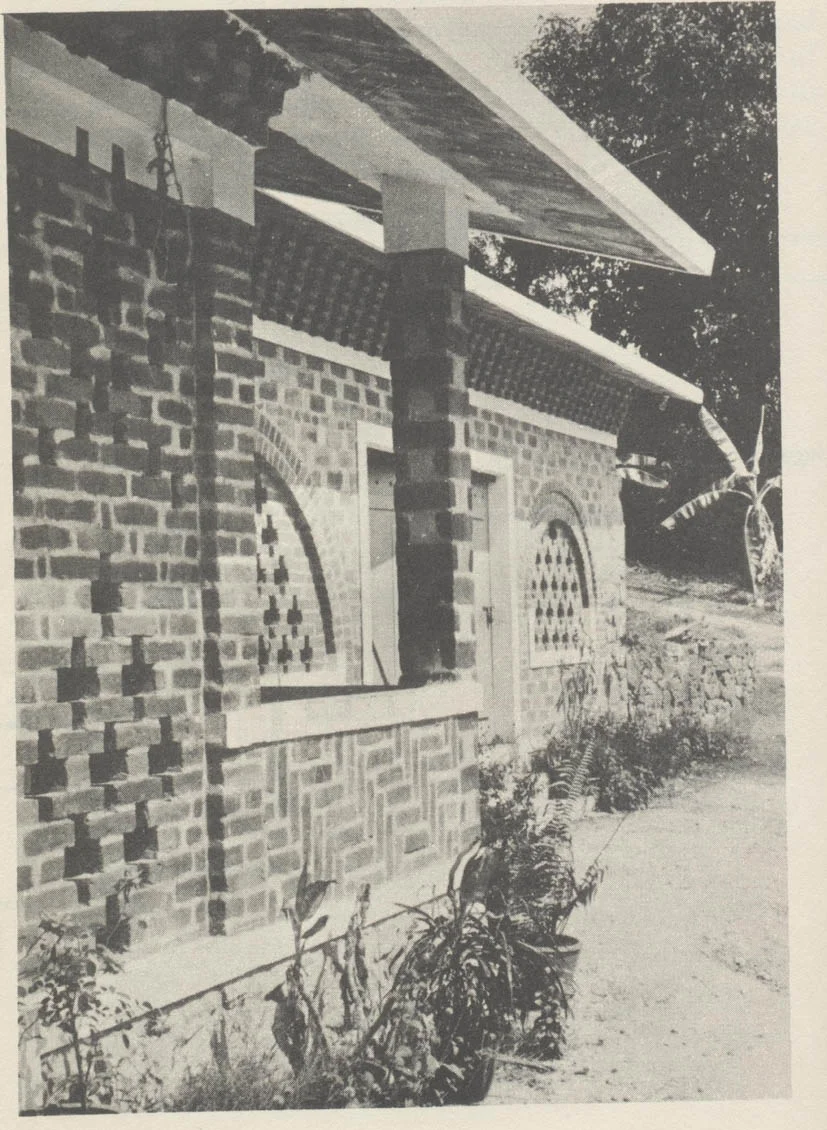 Nirmithi Kendra, Trivandrum
[1] Preamble to “The Habitat Agenda”, United Nations. [2] Sue Roaf, Manuel Fuentes, Stephanie Thomas, Ecohouse – A Design Guide, Architectural Press, 2001, p.93