
Starting with zero Sustainable Practices series
2014-03-04
Articles
(previously published in Buildotech, September 2010)
Vinod Gupta is rare among practicing architects - he has a Ph. D. in energy studies from IIT Delhi. In some ways, this fact helps frame his approach to architecture. Among the pioneers of the conscious practice of sustainable architecture in India, he seeks to balance the demands of scientific rigour with that of practical pressures in the all too real world of building.
Gupta graduated from School of Planning and Architecture (SPA) in 1969 with a strong commitment to the issue of social housing and what would later be called sustainability. Immediately after graduation, he went to Denmark to work with an architectural firm that specialized in prefabricated housing. In the course of 2 years there he realized the inapplicability of that approach to Indian conditions. On his return he began teaching full time at SPA from 1973, continuing till 1989. In 1982 he set up a partnership firm with class fellow Rasik Behl which lasted till 1998. Gupta’s current firm Space Design Consultants was established in 1998 in partnership with L. P. Singh, an architect who had been a colleague from Gupta’s early days.
Research and practice
The first energy crisis occurred just when he began teaching, as Arab countries stopped supplying oil to the West since the USA was providing arms to Israel. ‘The price of oil doubled almost overnight’ Gupta remembers. ‘This was repeated again in 1978-79 and it became obvious that the world had to do something to reduce its dependence on oil. For architects it meant using as little energy as possible. In cold climates passive solar architecture was the way of providing comfort in buildings without installing mechanical equipment. In moderate climates it was possible to provide heating and cooling with passive solar architecture but in warm climates it was not possible to cool sufficiently with passive solar architecture to provide a high level of comfort. This was a time when the field was new and I plunged into it, developing teaching material and making several experimental buildings keeping repeatability in mind. Most passive solar architecture at this time consisted of esoteric houses that might have looked appropriate on the moon. The energy crisis brought about some fresh thinking on environmental problems also. The linkages between energy- environment & ecology began to be better understood’.
To strengthen his understanding, Gupta enrolled for a Ph. D. in Energy Studies at IIT Delhi in 1984. This allowed him to work closely with physicists who themselves had little understanding of architecture. In the period up to 1987 when he completed his Ph D, Gupta also built experimental buildings in New Delhi, Srinagar and Jodhpur.
‘The one in Jodhpur developed new ideas about using shafts for ventilation as opposed to windows, passive down draft towers and using displacement ventilation as opposed to the mixed mode that has been used with air conditioning,’ Gupta recalls. ‘The Srinagar building explored unconventional solar heating system using a traditional earth roofing system. But the most important result from the research was a better understanding of the buildings of Jaisalmer. It was the idea that a dense settlement created a comfortable thermal environment that did not exist in more sparse settlements’.
Innovation
Gupta has often been ahead of the game, in the matter of building sustainably. The experimental building in Jodhpur was already at the cutting edge of green techniques, but there were others too. ‘At the National Media Centre Housing project in Gurgaon, I was appalled to know that the 23 acre site was without water supply (other than subsoil water) and also without a proper system of drainage’ he recalls. ‘The site was 2 m below the highway and the drainage had to pass across the highway. To overcome these problems I devised a system that came to be called rainwater harvesting later. It took care of site drainage and provided a source of water supply’. Similarly, the CMC building was also ahead of its time in its office design concepts as well as building automation
Range and focus
The firm only does projects with a significant orientation towards sustainability. In the course of the last 3 decades Gupta has designed a range of projects of varying scale and programme- residential developments, hospitality facilities, office blocks, institutional complexes. The CMC building (built 1992) in Mumbai’s Bandra Kurla Complex, widely considered India’s first intelligent building, was his first major architectural project (See box). Among recently completed projects of note is the NIIT University near Neemrana in the desert of Rajasthan.
Gupta takes an ‘end-to-end’ approach to striving for sustainability in his work. Though his special expertise has been related to energy and buildings, he believes that it is not enough to reduce energy consumption of a building alone. Buildings are part of broader patterns of development (transportation networks, environmental management) and operation. There are also many dimensions to sustainability and focusing on energy alone is not enough. Equally, any effort at making a building sustainable can be rendered useless if the interior design (often handled by another consultant) goes the other way. Thus Gupta’s work spans the range from master planning, architectural and energy systems design, to interiors and sustainable furniture production. The last emerged as a focus, because Gupta realized that much modular furniture was designed from for the manufacturer’s convenience than the users’. Making his own furniture also makes it easier to integrate sustainability ideas into a project at the level of the smallest detail.
SDC also does a fair amount of experimentation at own cost, to be ready with feasible ideas when the opportunity comes along to apply them. This is useful in a context where projects have to be executed faster than ever before, leaving very little time for experimentation during the execution. But perhaps it is Gupta’s coordinating role in a project to redesign a manual rickshaw that brings together his interest in connecting macro-issues to micro-designs. 50 new bicycle rickshaws- designed to be easier to drive and ride in- are currently testing the prototype design on the streets of Gaya, which if successful could be an important contribution towards an energy efficient and socially equitable transport system.
Design approach
Energy is a central concern for Gupta in his approach to design. He recognizes that building is an act that destroys the environment. So he seeks to ensure that his buildings cause the least amount of damage, and consume the least amount of energy.
‘I start from zero’, he says referring to the energy consumption of his buildings. ‘We should be spending zero energy. It is not enough to compare with existing standards and say we are doing better. It is easy to look good that way. I don’t take that attitude. I should try to spend zero. How much I save is important even if I save 30 percent. I am unhappy in spending that itself’. Not surprisingly, then his unrated NIIT University, Neemrana, consumes half the energy consumed by the Platinum rated Godrej CII centre in Hyderabad which is itself much more energy economical than many corporate offices with high green ratings.
In general, Gupta prefers to look at the simplest design and technological solutions first, opting for complex solutions as little as possible. For example, he prefers to begin with non-mechanical systems for cooling and heating, introducing air conditioning into his buildings only when absolutely necessary. This contrasts with current practice especially in corporate, retail and entertainment architecture (and often even in green rated buildings) which takes air-conditioning for granted, and only tries to use more efficient systems consuming less energy.
Aesthetics and Sustainability
Gupta reveals an interesting shift in his approach to aesthetics. For a while, he believed that a green building should look no different from any other building of a similar kind. But over time he has come to believe that sustainable architecture might need to develop its own range of visual identities in an internally consistent manner. This is because the public forms opinions about substantive issues like sustainability, often on the basis of visual cues. Now, he is more inclined to explore unique aesthetic possibilities that sustainable design and technology offer. Thus, a practice that began largely with scientific exploration (with an attitude that kept aesthetics away from the centre) towards the agenda of sustainability, is now moving towards a greater attention to aesthetics, mainly to further the same agenda. Practice comes full circle sometimes.
Architect’s Project Notes
Computer Maintenance Corporation, Mumbai (1992)
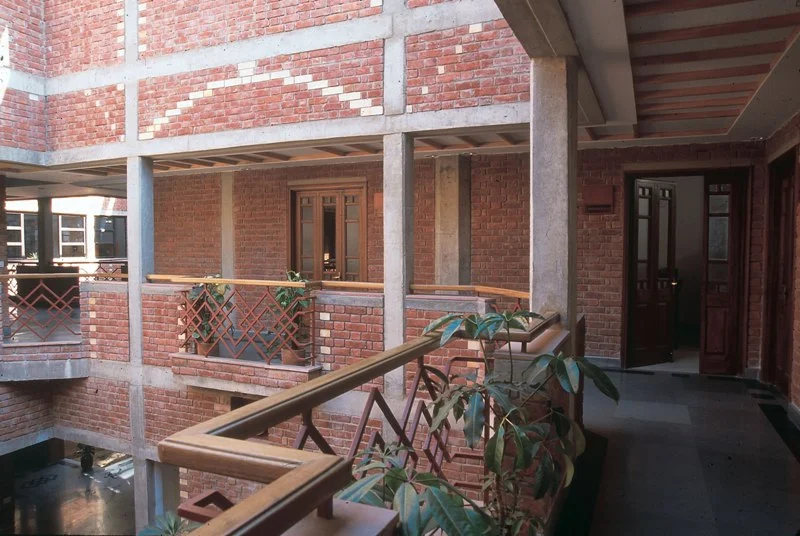
 This was the first intelligent building to be built in India and at the time when it was built, it had more intelligent features than other buildings anywhere. I was looking for an architectural expression that would result from building intelligence. Most of Mumbai's buildings acquire the dark fungus after a few seasons and I decided to use glass as a cladding material that would be free of fungus. The building itself was designed as a spiral growing upwards, where one could easily walk all the way to the top floor without feeling tired. This was achieved by having no more than five risers in a flight a time. It was also a building in which sculpture was integrated with architecture. From an environmental perspective, the building set new standards for use of materials. Hard woods were kept out and instead all furniture was made from rapidly renewable materials like rubber wood, bamboo and cane. The building had artificial lighting integrated with daylighting. Special Venetian blinds were used as light shelves. The building envelope had no more than 25% glass although it ended up looking like a building with curtain wall. Much of the glass was only cladding with opaque insulation behind it. The building used 20% less air conditioning than similar buildings in Bombay and the lighting power density was less than what ECBC prescribes today. The Building Management System (BMS) was integrated with office automation and the building was the first one to use hot desking in India.
NIIT University, Neemrana (2009)
This was the first intelligent building to be built in India and at the time when it was built, it had more intelligent features than other buildings anywhere. I was looking for an architectural expression that would result from building intelligence. Most of Mumbai's buildings acquire the dark fungus after a few seasons and I decided to use glass as a cladding material that would be free of fungus. The building itself was designed as a spiral growing upwards, where one could easily walk all the way to the top floor without feeling tired. This was achieved by having no more than five risers in a flight a time. It was also a building in which sculpture was integrated with architecture. From an environmental perspective, the building set new standards for use of materials. Hard woods were kept out and instead all furniture was made from rapidly renewable materials like rubber wood, bamboo and cane. The building had artificial lighting integrated with daylighting. Special Venetian blinds were used as light shelves. The building envelope had no more than 25% glass although it ended up looking like a building with curtain wall. Much of the glass was only cladding with opaque insulation behind it. The building used 20% less air conditioning than similar buildings in Bombay and the lighting power density was less than what ECBC prescribes today. The Building Management System (BMS) was integrated with office automation and the building was the first one to use hot desking in India.
NIIT University, Neemrana (2009)
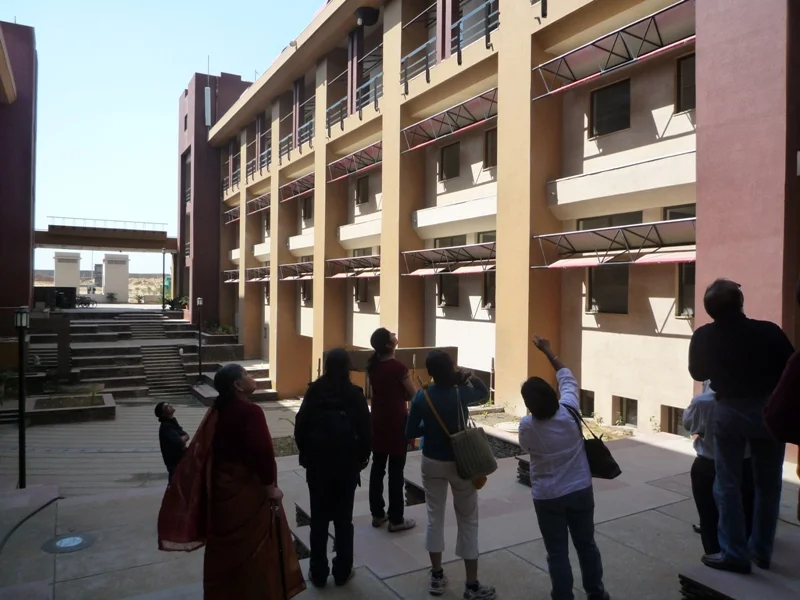
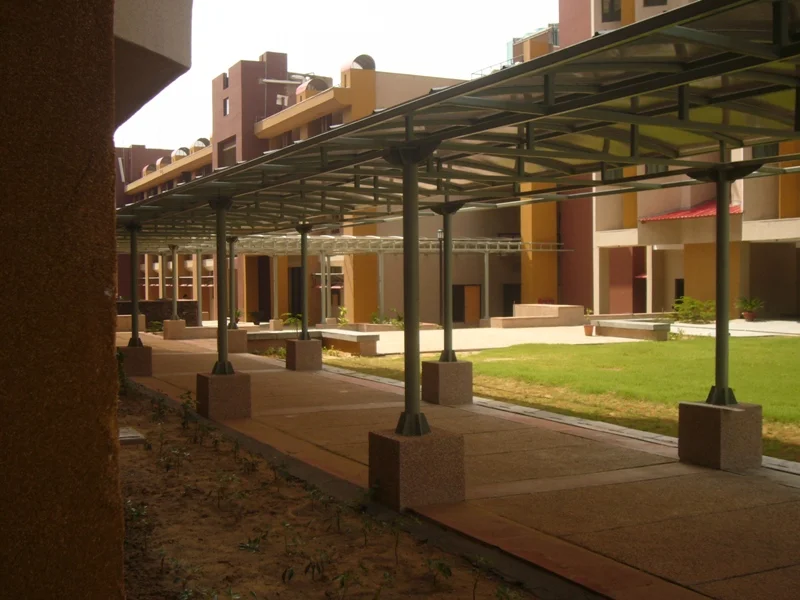 Ever since the experience of Jaisalmer, I wanted an opportunity to define standards for modern buildings in the hot arid region. We started work on NIIT University at Neemrana in 2005 and it was commissioned in 2009. It is not sufficient to make buildings 'green' as defined by the rating systems. Such buildings have no chance of making any great impact on the national environmental scene. Much more than simple rules of efficiency need to be applied and the 100 acre University campus next to an outcrop of Aravali hills provided this opportunity. It is designed as a car free campus, a place that is tightly built like a traditional town in Rajasthan. The open spaces are more important than the buildings. The open and built space matrix has been designed to provide better lighting than is available in traditional towns. Everyone worries about the heat in the desert but my concern has been equally with water and dust. The NIIT campus provides alternative solutions for both of these issues. The campus will rely on rain water for its needs and the buildings are designed to work with a 100% fresh air ventilation system that will keep dust out. Air pre-cooled by a geothermal system and cooled further by a mechanical system is circulated in the building using vertical shafts. Day lighting reduces the need for artificial lighting dramatically. The academic building is not rated by LEED or GRIHA but it is so energy efficient that sets a new green standard. Its energy consumption is one sixth that of LEED Platinum rated Wipro Technologies, Gurgaon, one fourth that of LEED Platinum rated ITC Green Centre, Gurgaon and one third that of Griha 5 star rated CESE building at IIT Kanpur. It shows clearly that the standards we are using for green buildings are meaningless for the Indian context.
This was the first intelligent building to be built in India and at the time when it was built, it had more intelligent features than other buildings anywhere. I was looking for an architectural expression that would result from building intelligence. Most of Mumbai's buildings acquire the dark fungus after a few seasons and I decided to use glass as a cladding material that would be free of fungus. The building itself was designed as a spiral growing upwards, where one could easily walk all the way to the top floor without feeling tired. This was achieved by having no more than five risers in a flight a time. It was also a building in which sculpture was integrated with architecture. From an environmental perspective, the building set new standards for use of materials. Hard woods were kept out and instead all furniture was made from rapidly renewable materials like rubber wood, bamboo and cane. The building had artificial lighting integrated with daylighting. Special Venetian blinds were used as light shelves. The building envelope had no more than 25% glass although it ended up looking like a building with curtain wall. Much of the glass was only cladding with opaque insulation behind it. The building used 20% less air conditioning than similar buildings in Bombay and the lighting power density was less than what ECBC prescribes today. The Building Management System (BMS) was integrated with office automation and the building was the first one to use hot desking in India.
NIIT University, Neemrana (2009)
Ever since the experience of Jaisalmer, I wanted an opportunity to define standards for modern buildings in the hot arid region. We started work on NIIT University at Neemrana in 2005 and it was commissioned in 2009. It is not sufficient to make buildings 'green' as defined by the rating systems. Such buildings have no chance of making any great impact on the national environmental scene. Much more than simple rules of efficiency need to be applied and the 100 acre University campus next to an outcrop of Aravali hills provided this opportunity. It is designed as a car free campus, a place that is tightly built like a traditional town in Rajasthan. The open spaces are more important than the buildings. The open and built space matrix has been designed to provide better lighting than is available in traditional towns. Everyone worries about the heat in the desert but my concern has been equally with water and dust. The NIIT campus provides alternative solutions for both of these issues. The campus will rely on rain water for its needs and the buildings are designed to work with a 100% fresh air ventilation system that will keep dust out. Air pre-cooled by a geothermal system and cooled further by a mechanical system is circulated in the building using vertical shafts. Day lighting reduces the need for artificial lighting dramatically. The academic building is not rated by LEED or GRIHA but it is so energy efficient that sets a new green standard. Its energy consumption is one sixth that of LEED Platinum rated Wipro Technologies, Gurgaon, one fourth that of LEED Platinum rated ITC Green Centre, Gurgaon and one third that of Griha 5 star rated CESE building at IIT Kanpur. It shows clearly that the standards we are using for green buildings are meaningless for the Indian context.