
Sustainable Interiors
2014-02-28
Articles
The idea of sustainable interiors seems to be confused with LEED certification for GREEN interiors. By USGBC definition green interiors for commercial buildings are high performance, healthful, durable, affordable, environmentally sound commercial interiors. To achieve this, LEED requires:
Please notice that getting LEED points was not an issue but keeping costs down was. Once these decisions were made design was easy and the goals were met through design.
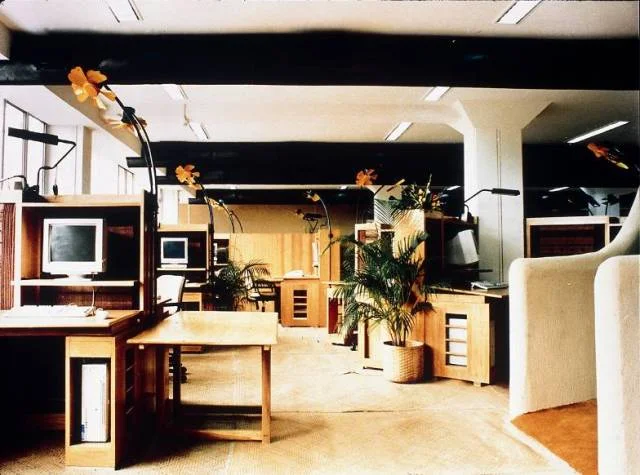
Rapidly renewable materials like bamboo, cane, rubber wood, palm leaf were used for furniture. High quality Goods produced by craftsmen with these materials were used. Other local crafts like hand made cement tile flooring with inlaid designs and hand woven textiles were also used. Hard woods like teak (In India, these come mainly from forests) were not used. Coir matting and palm leaf mats were used for flooring.
Office interiors have a short life span because of changing requirements. All Furniture was designed as self supporting modules that could be rearranged and reused easily. Built in furniture was avoided.
Energy Efficiency: The office was located at the top floor of the building and in order to reduce the air conditioning load, the roof was insulated from the top and finished with a reflective material. The windows faced east and west. Tighter windows were installed and they were shaded from outside. The cafeteria was moved to the roof top and made as a naturally ventilated and cooled space. Individual air conditioners were installed in meeting rooms, so that they could be shut off when not required. The connected power load for lighting was reduced by using task lighting.
The greatest reduction in energy used in air conditioning came from task cooling fans. Each workstation had its own low speed, low noise air circulation fan. This allowed the use of a higher temperature setting for the air conditioning system, provided comfort for individuals when the main plant was shut off and also increase the number of days (with cooler weather) when the office could function without air conditioning.
Daylight: The windows were shaded with external blinds. The most active part of the office - the cafeteria was moved to the roof top - to a non air conditioned space that had a nice view of South Calcutta.
Personal Health: The furniture was designed with ergonomics in mind. At the time, the office was built, software engineers still did some paper work. The monitors were elevated to a more ergonomic level and the table were left clear. This allowed the tables to be made height adjustable and the table top height was lowered and keyboard trays were done away with.
To provide people with alternatives to the seated position – a stressful position not very good for the spine - an area was set aside in the middle of the office, where people could be free of chairs and sit in different postures for meetings, even lie down if they wished to. This was the place to contemplate, meditate and rejuvenate.
There were many smokers in the office and the outdoor cafeteria allowed the rest of the office to be designated as a tobacco smoke free zone.
One can see that in each case a higher performance level was achieved through design and not merely through a change of specifications. The need for air conditioning was reduced first and then an ordinary air conditioning plant was used. The personal cooling fans further reduced energy used for air conditioning. Similarly the need for artificial lighting was reduced first by shading windows, avoiding glare and providing task lamps for all workers.
The office space itself was used more efficiently by using hot desking ( a new idea in 1995) letting 75 people use an office space that had only 49 workstations. Above all people's health was not just made a sub set of indoor air quality but it dealt with real ` machine produced goods, specially when the latter come from a far away country.
Water use efficiency that LEED rated interiors deal with is an issue of specification and not so much of design. With the availability of water saving fixtures it is only a question of selecting the right fixtures.

- Location –public transportation availability for the building
- Energy Use Efficiency - including lighting and HVAC
- Water Use efficiency - primarily concerned with toilets but also with re-use of the waste water
- Materials for construction - regionally sourced materials
- Indoor air quality - meeting ASHRAE standards for thermal comfort and eliminating tobacco smoke
- Occupant well being and productivity
- Efficient use of resources
- Protection of the natural environment
- Promotion of social equity
| Issue | Sustainable Interiors Goal | Green Rated Interiors Goal | |
| Materials | Inexpensive, rapidly renewable, locally sourced materials produced by craftsmen must be used. | Regionally sourced, low embodied energy materials must be used. | |
| Layout | Seat as many people as possible to achieve operational efficiency | ||
| Energy | Use air conditioning and artificial lighting carefully and efficiently. As much of the office as possible should be day lighted and naturally ventilated. | Air condition the whole space to ASHRAE standards. | |
| Health | Find ways to relieve the stress that work at a computer terminal causes. Use Ergonomic furniture. Use plants to improve indoor air quality. | Avoid VOC emissions | |
| Social Equity | Promote crafts | Win LEED points |